
conco polybot.
A personal assistant that turns the Polymarket noise into, every day, a couple of reasoned recommendations that land straight in my Telegram.
Polymarket has thousands of active markets at any given moment. Most of them don't deserve your attention: thin volume, far-out resolutions, badly worded questions or probabilities already well-priced. PolyBot exists to do that filtering work every day, twice a day, and return only what genuinely deserves a second read.
On the candidates that survive the filter, the bot asks the AI model for a reasoned thesis: why the market might be mispriced, what factors support the idea, what risks would invalidate it and what conviction level a possible bet should carry. That thesis arrives summarized in an actionable format, not as an abstract paragraph.
The bot does not bet for me. It does not sign transactions, it does not touch the wallet. Its job is to give me a recommendation with enough context that I can decide in 30 seconds whether to act on it.
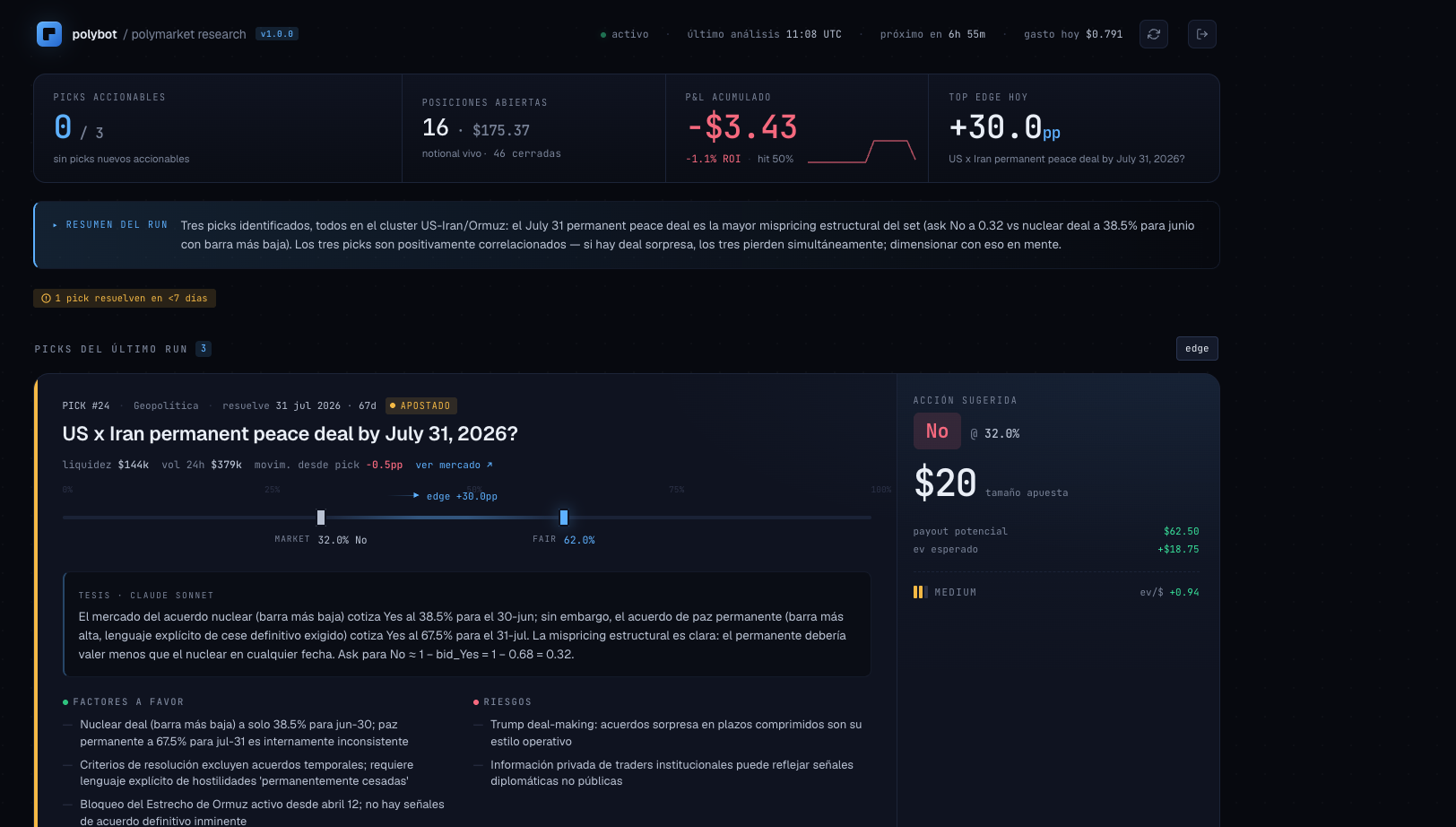
There are plenty of bots that ping you when a price moves. This isn't one of them. The difference is not speed, it's the reasoning behind each alert. Every pick comes with its original thesis, the signals the model identified in its favor and, crucially, what would have to happen to invalidate the recommendation.
On top of that sits an integration with the real on-chain wallet: the bot knows which positions I have open and never recommends something I'm already on. When an existing position enters a zone where it makes sense to close, lock profits or watch closely, I get a management recommendation, not an entry one — with its own reasoning adapted to the current market context.
The practical result is that I stop monitoring Polymarket manually. The bot does, and only interrupts me when it has something worth saying.
Everything lands in two places. On Telegram, twice a day, I receive the new picks and the suggested actions on what I already have open: each one with its thesis and a direct link to the corresponding market. That is the active flow.
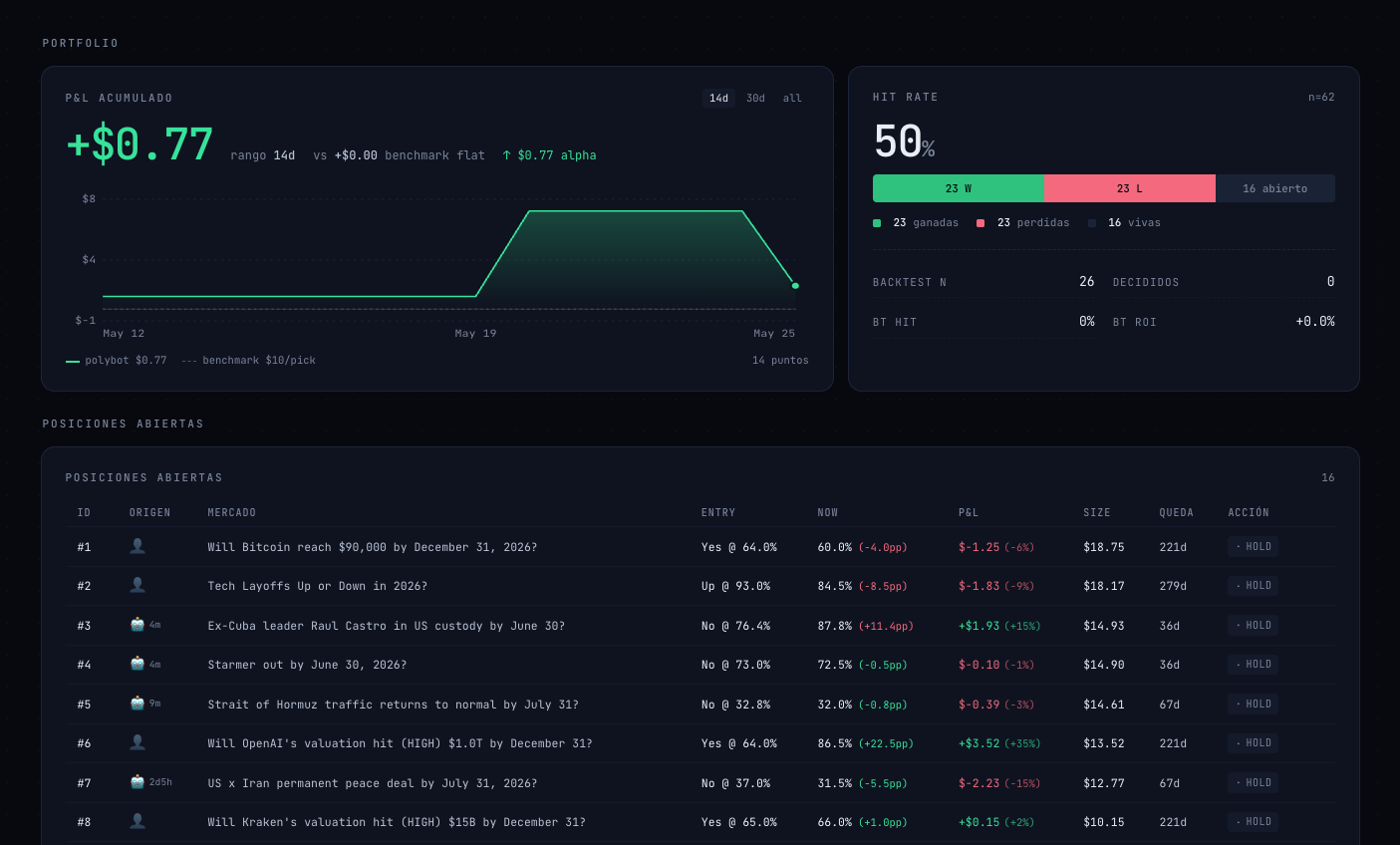
In parallel, a local dashboard shows the full picture: cumulative P&L, hit rate, which markets are live, which closed well, which badly and what the model discarded. It is the review view, not the action one — I check it when I want to understand why something is performing the way it is.
I don't sell the code or the setup. But I am happy to talk about how it's designed, what real problems it solves and how it could be adapted to similar use cases.
If you are building in this direction, if you want to apply AI to your own research flow or simply want to compare notes, reach out.